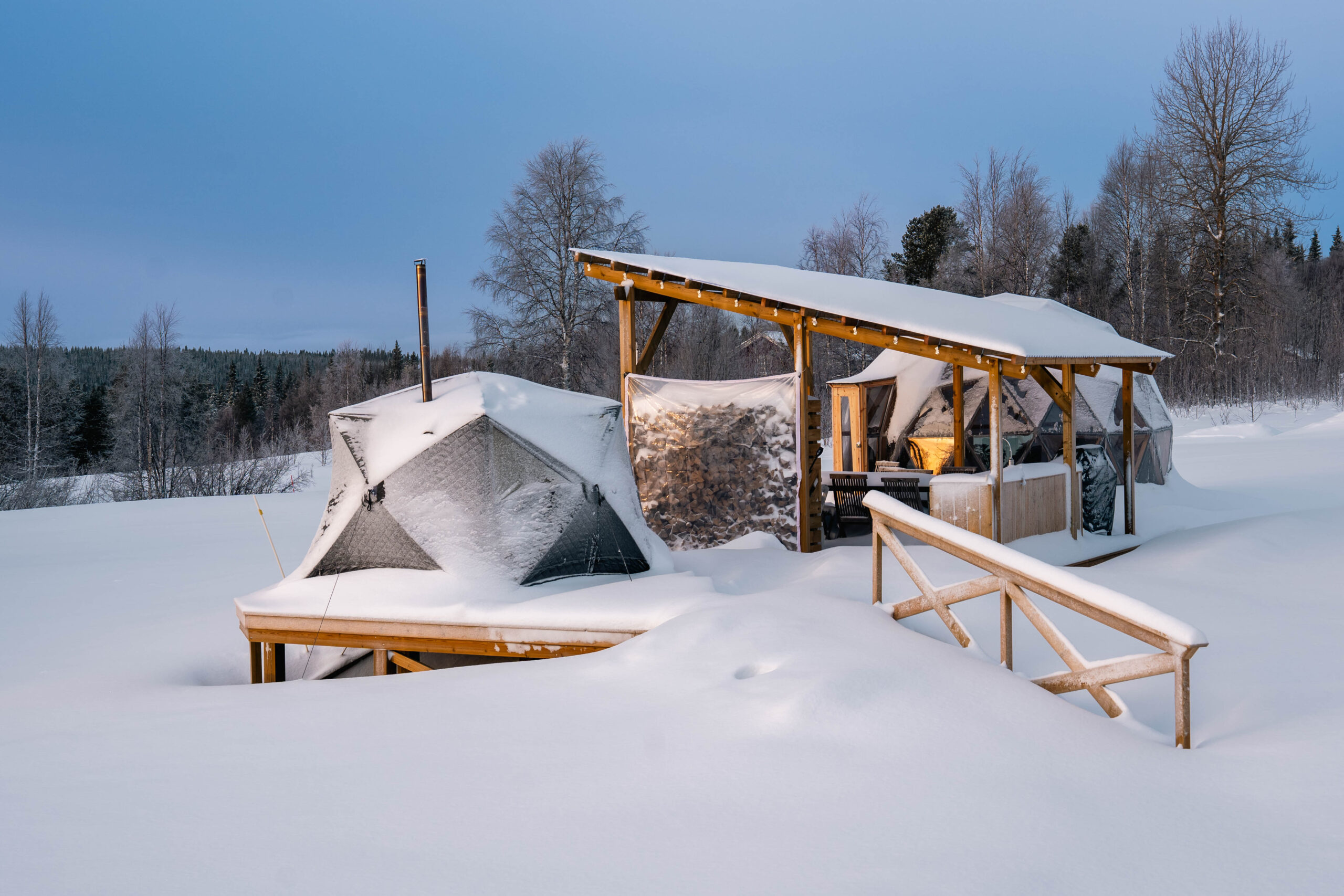
High on a mountain in the inland of northern Sweden, surrounded by forests, open landscapes, and nearly ten kilometres from the nearest neighbour, lies the place where our domes are developed and built. Here, everyday life is shaped by the changing seasons — from winter darkness, snow, and auroras to bright summer nights and the midnight sun.
What began as a place for rest and recovery gradually grew into something much bigger. The landscape, climate, and history of Granberget have become an important part of the philosophy behind Scandinavian Domes and continue to influence how we think about materials, durability, craftsmanship, and the experience of being close to nature. It is also here that our domes are tested and refined — not in laboratories or controlled environments, but in real Nordic conditions shaped by snow, wind, moisture, light, and darkness.
For us, life up here is not a marketing concept. It is simply where this story began.
The history of this part of Sweden is closely connected to the settler communities that emerged throughout the northern inland during the nineteenth century. The Swedish state encouraged people to settle these remote regions by granting large areas of land to families willing to build farms and create a life here. Generation after generation built their lives through forestry, farming, hunting, fishing, craftsmanship, and an extraordinary amount of hard work.
Over time, much of the forest land was acquired by the growing coastal forestry industry, helping shape several of the major forest companies that still exist today. Much of the land once owned by settler families gradually disappeared. But some remained. Today, the lands surrounding Granberget continue to shape both our lives and the philosophy behind Scandinavian Domes.
What began as a place for rest and recovery slowly developed into a deeper relationship with the landscape around us. During the pandemic, we started spending more and more time here — to change our surroundings, reconnect with nature, and create something meaningful in a place that once offered opportunity to earlier generations.
That journey eventually led us to our domes.
The environment around us continues to shape everything we do. Life here follows the rhythm of the seasons.
Spring arrives slowly with melting snow, rushing streams, and returning light. Summers are filled with long evenings, trout fishing, walks through the forest, and late nights beneath the bright Nordic sky. Autumn brings cooler air, deep colours, mushrooms and berries — and the first auroras drifting above the treetops. And then comes winter. Snow covers the landscape for months. Temperatures fall far below freezing. The forests grow quiet. Fire becomes important again. Light becomes precious. The sky constantly shifts between darkness, stars, moonlight, and green curtains of aurora.
It is in this environment that our domes are developed and tested. Not in laboratories or controlled studio environments — but in real Nordic conditions shaped by snow, wind, moisture, temperature fluctuations, and long periods of darkness and light.
The landscape around us continually influences how we think about materials, warmth, shelter, durability, and the feeling that emerges when spending time inside a dome. Because in the end, Scandinavian Domes is not simply about buildings. It is about creating places where people can slow down, reconnect with nature, gather around the fire, and experience a sense of calm that has become increasingly rare in modern life.
For us, life up here is not a marketing concept. It is simply where this story began.
During the summer of 2026, we selected three pilot partners from almost 100 applications from Sweden and abroad. The pilot year has now begun with installations in Hemavan, Åre and Borgafjäll.
Under sommaren 2026 valde vi ut tre pilotkunder bland närmare 100 intresseanmälningar från Sverige och andra länder. Pilotåret har nu inletts med installationer i Hemavan, Åre och Borgafjäll.
Tillsammans med våra pilotkunder kommer vi under det kommande året att vidareutveckla varje del av Scandinavian Domes – från materialval och hantverk till logistik, installation och långsiktig hållbarhet – inför den bredare marknadslanseringen 2027.